V-JEPA 2: Self-Supervised Video Models Enable Understanding, Prediction and Planning
Background
Exponential Moving Average(EMA)
\[\bar{\theta} = \alpha \cdot \bar{\theta} + (1-\alpha)\cdot\theta\]- EMA: a method for creating a slowly updating copy of the model weights.
In the equation, alpha is usually a number close to 1, so the degree to which the previous weights are updated toward the new weights is very small. That is, it becomes a smoothed average of past encoder weights.
The reason the paper uses an EMA encoder as the target encoder is that the target is also not fixed, so it is used to prevent representation collapse, i.e., to prevent the encoder from learning a trivial solution that maps a huge number of inputs to a single latent vector.
Cross-Entropy Method (CEM)
A sampling-based optimization for finding the optimal action sequence in a continuous action space. Used during the planning stage to minimize energy.
Algorithm
- Randomly sample action sequences from a Gaussian distribution
- Roll out each sequence with the world model and evaluate the energy
- Keep only the top-k trajectories with the lowest energy, and update the mean and variance of the sampling distribution
- After repeating for several iterations, return the mean of the final Gaussian as the action
Stop-Gradient
Stop-gradient is an operation that prevents gradients from backpropagating along a particular computation path.
In the paper, stop-gradient on \(E_{\bar{\theta}}(y)\) means:
- The target representation is computed but treated as a constant
- Gradients update only the encoder \(E_{\theta}\) and predictor \(P_{\phi}\), and do not update the target network
- Together with EMA, it serves to prevent representation collapse
L1 Loss vs L2 Loss
- L1 loss is robust to outliers and encourages sparsity
- L2 loss is sensitive to outliers and has a stronger tendency to penalize large errors
⇒ In representation learning, L1 loss is more robust to unpredictable & noisy aspects of video.
Since JEPA focuses on learning predictable aspects (like object trajectories) while ignoring unpredictable details (like exact positions of leaves), L1’s robustness to outliers is beneficial.
Rotary Position Embedding
\[\text{RoPE}(x, pos) = R_{pos} \cdot x\]: Instead of adding a position embedding, it applies a rotation matrix according to position.
Advantages
- Naturally encodes relative position; attention between positions m and n depends on m - n
- Better extrapolation on long sequences
- More stable training in large models
Multiblock Masking Strategy
A strategy that samples several block-shaped regions and masks them all at once. Taken directly from V-JEPA.
-
The spatial mask scale is [0.15, 0.7], and the temporal mask scale is [1.0, 1.0]
⇒ Each mask block is applied across the entire time axis. That is, a specific spatial region is masked out entirely across all frames.
-
This creates a much harder prediction task than simple random masking, forcing the model to infer motion and structure from the remaining context.
Ego Vids vs Exo Vids
- egocentric video = first-person perspective
- exocentric video = third-person perspective
Model Predictive Control
A receding-horizon control approach where, given a goal image, at every step the action sequence is optimized over a finite planning horizon, only the first action is executed, and then re-planning is done with the new observation.
\[\mathcal{E}(\hat{a}_{1:T};\, z_k, s_k, z_g) = \bigl\Vert P(\hat{a}_{1:T};\, s_k, z_k) - z_g\bigr\Vert _1\]- V-JEPA 2-AC defines the energy as the L1 distance between the goal representation \(z_g\) and the imagined future state, and searches for actions that minimize it using CEM.
- Because it re-plans at every step, prediction errors can be corrected on the fly.
End-effector state
A vector representing the state of the tip of the robot arm, i.e., the gripper.
- In the paper it is represented as 7D: 3D Cartesian position + 3D orientation (extrinsic Euler angles) + 1D gripper state.
- The action \(a_k\) is defined as the change in end-effector state between adjacent frames. It is likewise 7D.
Motivation
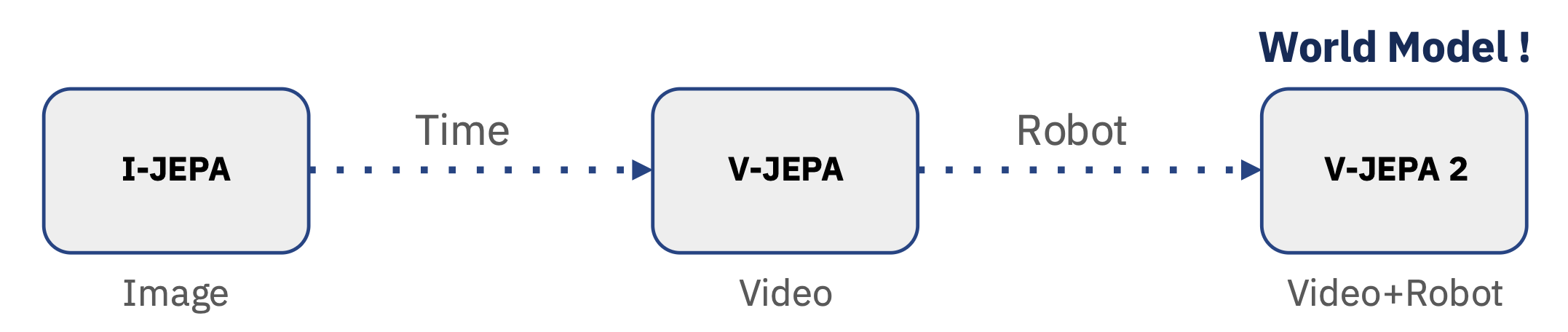
- More than 90% of human knowledge exists not in text but in experience with the physical world, and common sense about physical laws is acquired through visual observation rather than language.
- BUT LLMs only predict the next word, without a world model, reasoning, or planning.
Limitations of existing world model approaches
-
Relying solely on interaction data
⇒ Real interaction data is scarce, so scalability is poor.
-
Learning action-conditioned video generation from internet-scale video
⇒ Pixel generation is expensive and biased toward the visual fidelity of predictions, so cases that actually demonstrate planning or control are rare.
⇒ Instead of directly generating pixels, JEPA predicts the next state in a learned representation space. By focusing on predictable elements like object trajectories and ignoring unpredictable details like grass or leaves, the goal is to efficiently learn representations with understanding & prediction capabilities from large-scale observation data, and use these as the basis for zero-shot planning.
Contribution
- Representation-space prediction: It predicts the future in a learned latent rather than generating it as pixels. Because it focuses on predictable structure and discards noisy detail, the planning cost is much lower than generative world models.
- Decoupling observation from interaction: It first secures general-purpose representations via action-free pretraining, then trains only a lightweight action-conditioned predictor on a small amount of interaction data while keeping the encoder frozen ⇒ a structure that obtains a task-agnostic world model while minimizing dependence on robot data.
- Planning via MPC: Rather than cloning a policy with imitation learning, it infers actions via MPC that minimizes latent energy with CEM. It requires no expert trajectories, can use both success and failure data, and needs no reward.
- Language alignment without language supervision: Even without an encoder pretrained on image-captions, an encoder trained on purely visual observation shows competitive performance on VidQA, revealing that a video encoder is more advantageous for spatiotemporal understanding than an image encoder.
Method
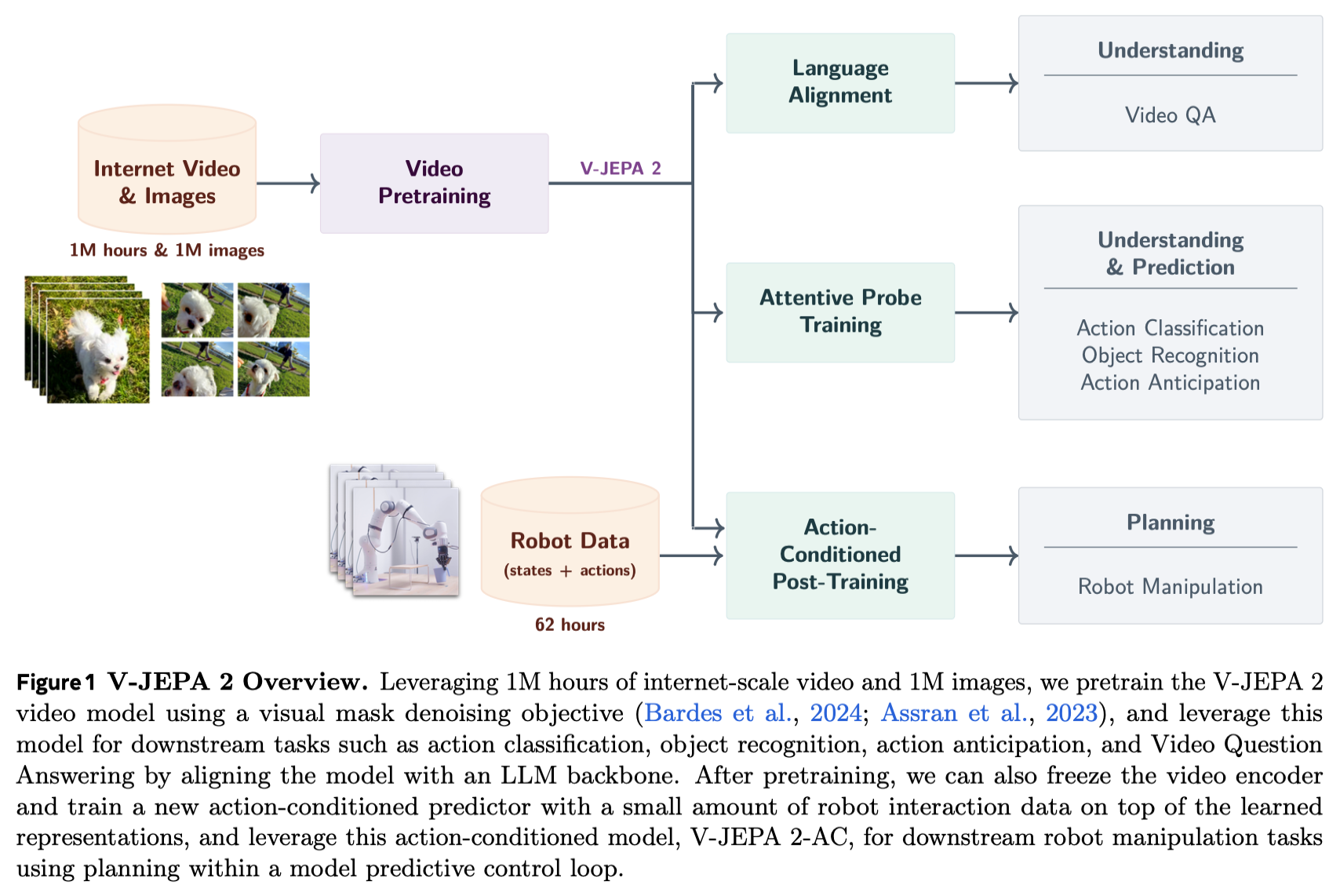
The overall pipeline is a stage-wise structure of action-free pre-training → action-conditioned post-training → MPC inference.
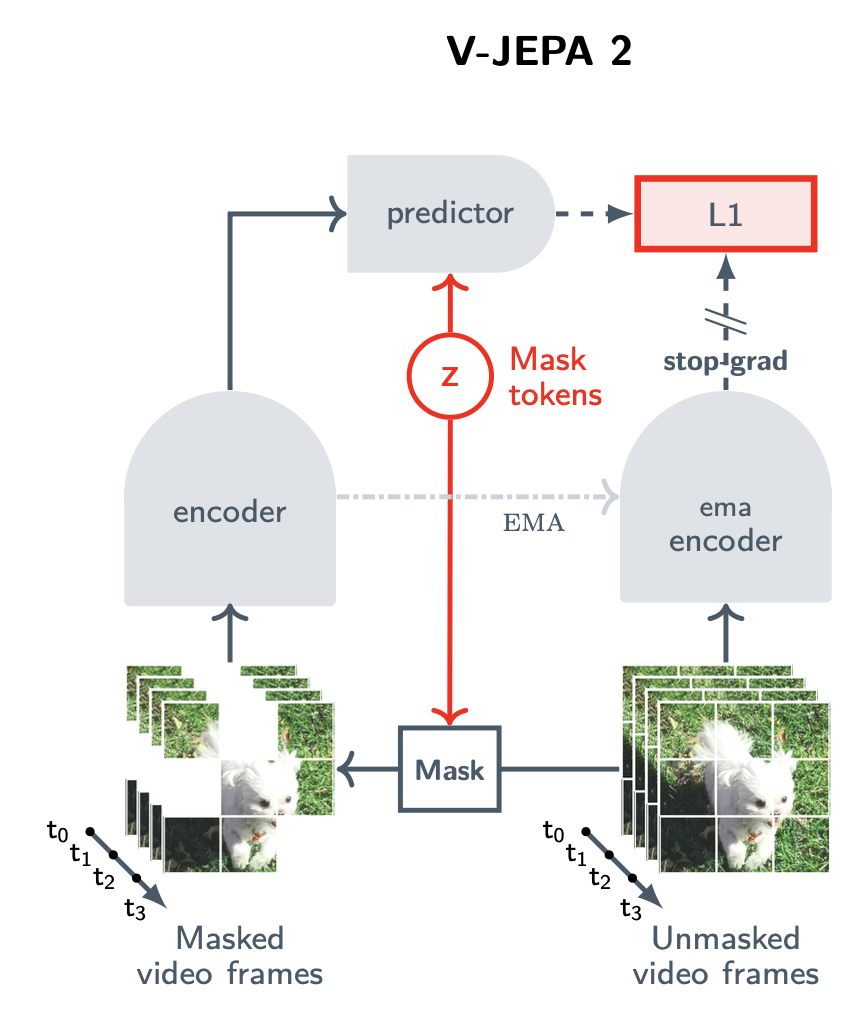
Stage 1. Action-Free Pre-training (Observation)
: The stage that learns world representations from observation alone.
\[\text{minimize}_{\theta,\phi,\Delta_y}\;\bigl\Vert P_\phi(\Delta_y,\, E_\theta(x)) - \mathrm{sg}(E_{\bar\theta}(y))\bigr\Vert _1\]- Data: VideoMix22M, 1M+ hours of internet video. Learns world representations from observation alone.
- Architecture: Masked Modeling. The ViT-g encoder is trained to predict the latent representation of masked video, learning semantic features.
- Objective, Mask-Denoising: The video is patchified into 2×16×16 tubelets and some tokens are masked. The encoder processes the remaining tokens, and the predictor predicts the representation of the masked parts. The target is computed by the EMA-encoder and the L1 distance is minimized.
- Here it predicts the latent, not the pixels.
- Key strategies
- EMA Encoder + stop-gradient: Delays target parameter updates to prevent model collapse
- RoPE: Instead of sincos position embedding, applies rotary position embedding separately to temporal, height, and width
-
Progressive resolution
: The warmup and constant phases use short, low-resolution clips, and only in the cooldown phase are the number of frames and resolution increased. This saves GPU time compared to training with long clips and high resolution from the start.
- Four scaling ingredients: data 2M→22M videos, model ViT-L 300M→ViT-g 1B, longer training 90K→252K iters, higher resolution & duration. The four factors cumulatively raise the average accuracy on understanding tasks from 84.2 to 88.2.
Stage 2. Action-Conditioned Post-training (Interaction): V-JEPA 2-AC
- Data: 62 hours of unlabeled robot video from Droid. 4-second clips, 4fps, Franka Panda 7-DoF arm. Uses only raw video and end-effector state, without reward, success/failure, or task labels.
- Architecture: An autoregressive structure that freezes the Stage 1 encoder and attaches only a lightweight predictor on top.
- Structure: An autoregressive world model that freezes the Stage 1 encoder and adds only a 300M-scale block-causal transformer predictor on top. It interleaves the end-effector state and 7D action into the per-frame independently encoded feature maps to predict the next state.
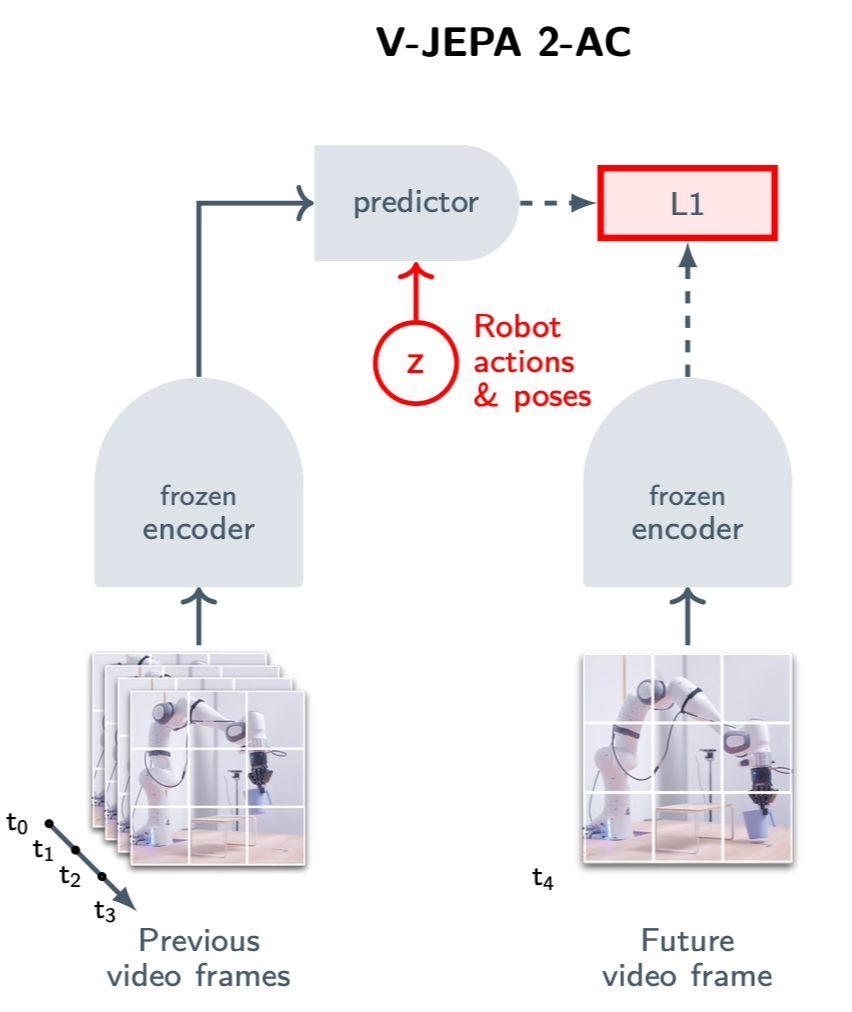
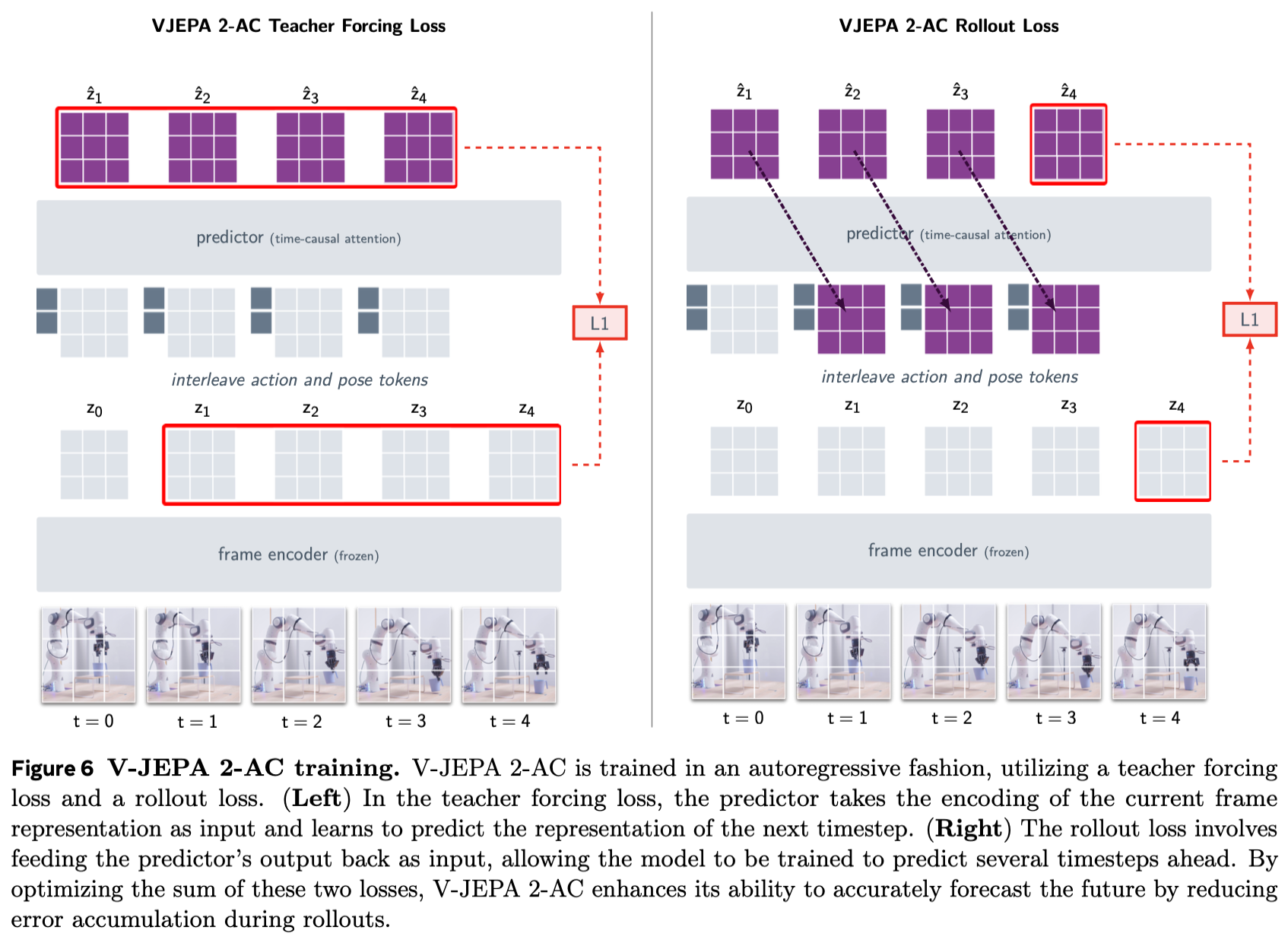
- Loss: the sum of teacher-forcing and rollout.
- teacher forcing: Learns 1-step dynamics with GT as input at every step. It prevents accumulation of early errors but creates a mismatch with inference.
- rollout: Learns to reduce long-horizon error accumulation by feeding its own predictions back in as input. The loss is computed as \(T=2\), differentiating only a single recurrent step.
Teacher Forcing vs Rollout
| Teacher Forcing | Rollout | |
|---|---|---|
| predictor input | Actual observation \(z_k = E(x_k)\) at every step | Reuses its own prediction as the next step’s input |
| comparison target | Prediction \(\hat{z}_{k+1}\) vs actual \(z_{k+1}\) | \(\hat{z}_{T+1}\) predicted autoregressively starting from \(z_1\) vs actual \(z_{T+1}\) |
| what is learned | 1-step dynamics based on past observations | Long-horizon dynamics traced over multiple steps |
| purpose | Prevent error accumulation from the initial step | Prevent error accumulation during long-horizon inference, correcting previous step’s prediction errors |
| limitation & complement | Train-test mismatch. At inference, the model’s own predictions are used as the next input instead of GT, so errors can accumulate | Complements this mismatch. Enables the model to continue tracing the future using imagination alone |
Inference: Model Predictive Control (MPC)
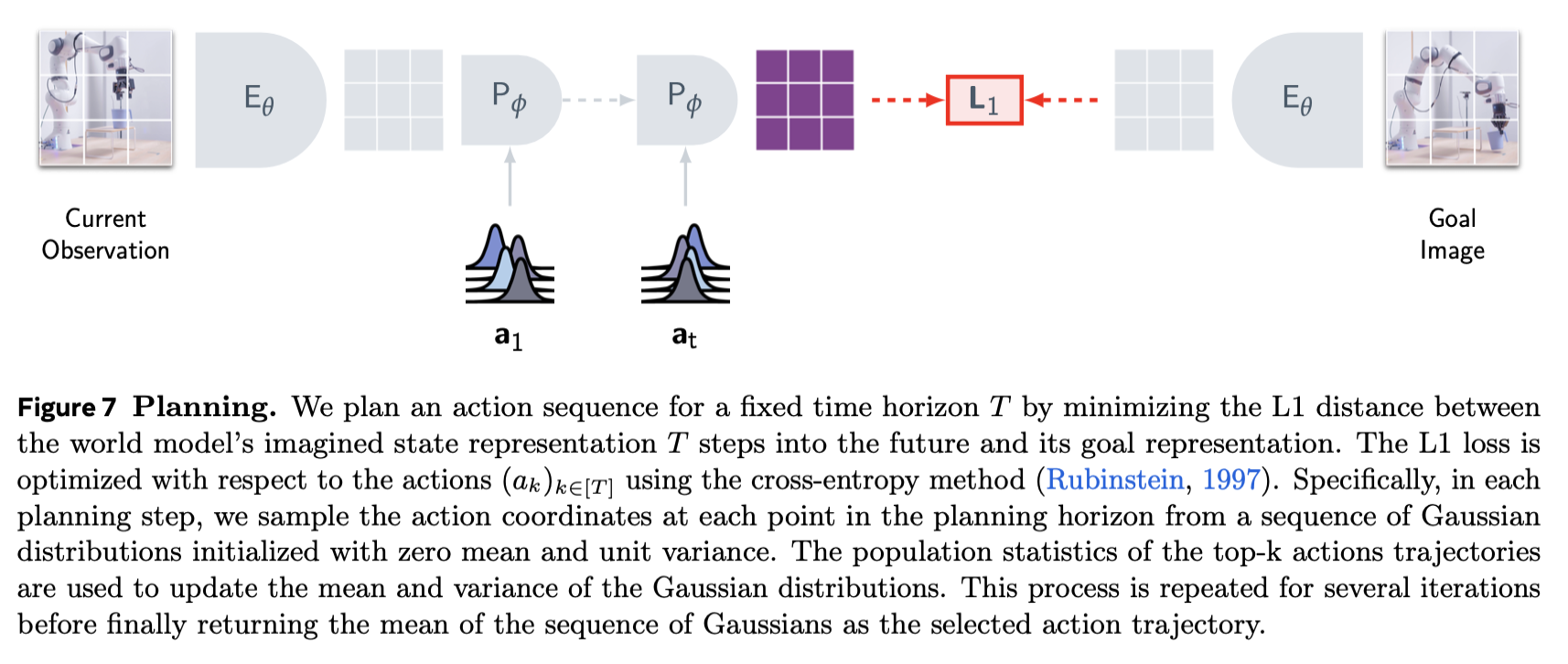
- Defines the energy as the L1 distance between \(z_g\), the encoded goal image, and the imagined future state.
- At every step, uses CEM to search for the action sequence that minimizes the energy, then executes only the first action and re-plans. Receding horizon.
Experiment
Understanding
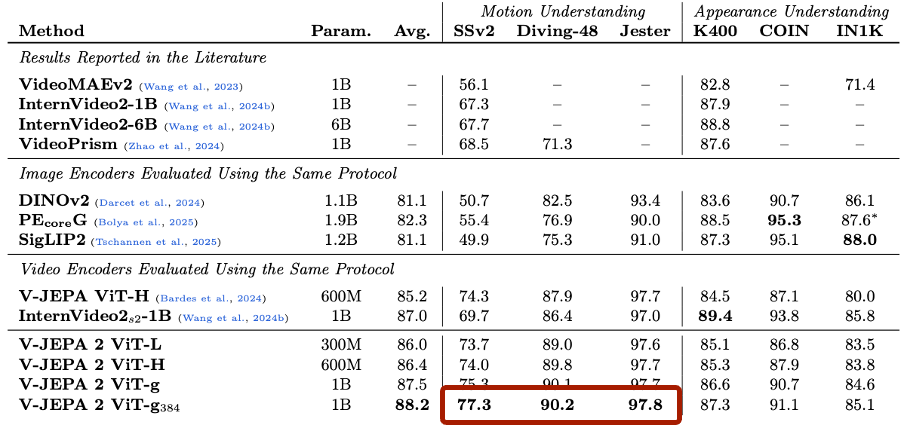
Action & Object Classification (frozen): V-JEPA 2 ViT-g384 surpasses image and video encoders with an average of 88.2 across 6 tasks. It is particularly strong at motion understanding, beating existing video models with 77.3 on SSv2.
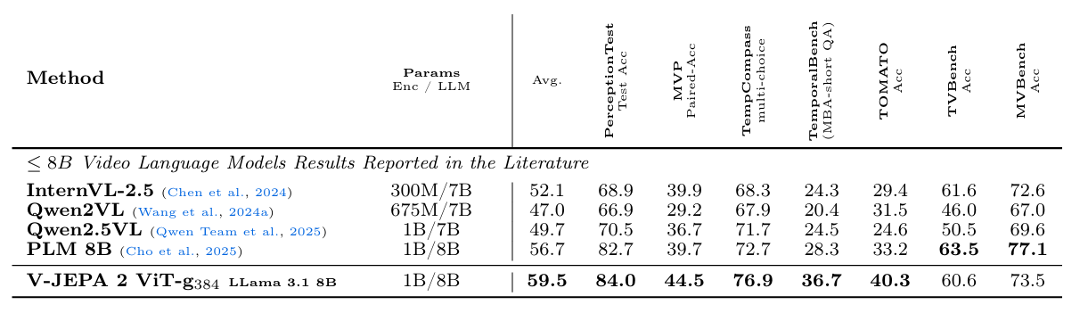
Video QA: The combination of ViT-g384 with alignment data expanded to 88.5M and Llama 3.1 8B achieves 8B-class SOTA with PerceptionTest 84.0, MVP 44.5, TempCompass 76.9, TemporalBench 36.7, TOMATO 40.3. This suggests that an encoder trained only on video without language supervision understands physical laws more accurately than text-based models.
Prediction
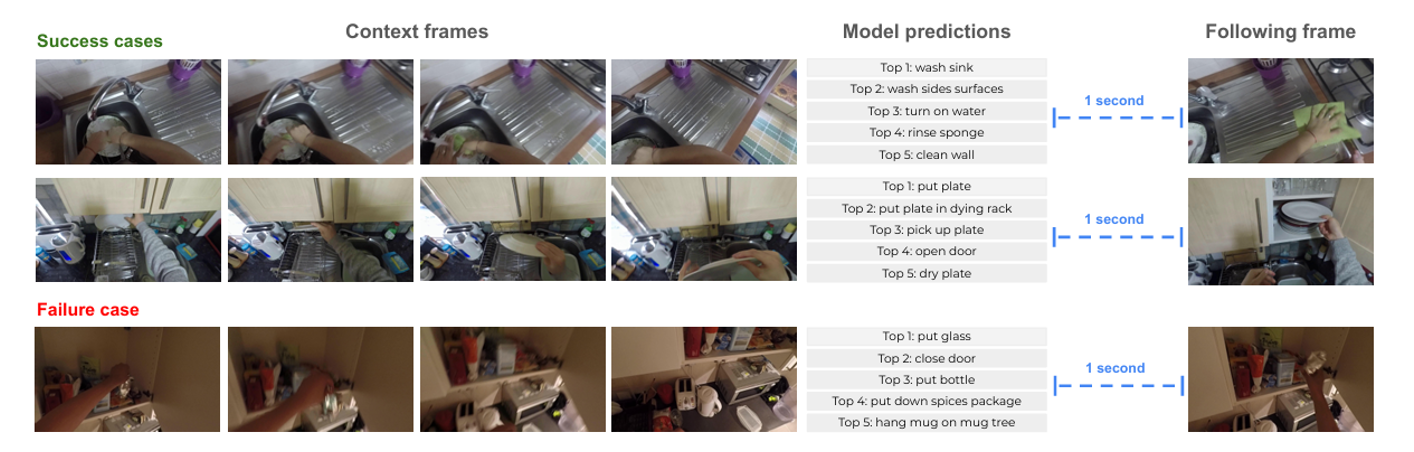
Qualitative: Understanding the context of being in front of a sink, it simultaneously infers multiple physically plausible candidates such as turning on the water or rinsing the sponge. However, accuracy drops once the prediction time exceeds 1 second.
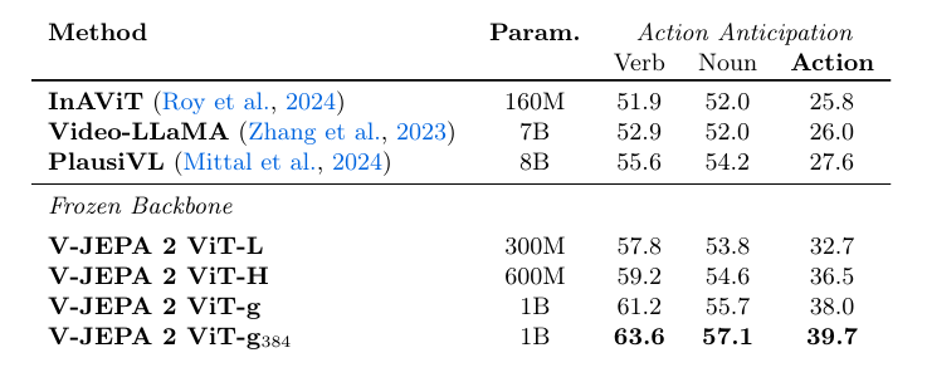
EK100 Action Anticipation: Predicts the action 1 second later from video context. ViT-g384 achieves 39.7 action recall-at-5, a 44% relative improvement over PlausiVL, which is 8x larger.
Robot Planning
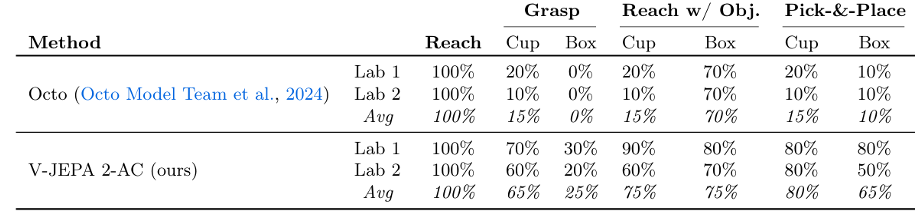
Zero-shot manipulation: Performs Grasp, Reach w/ Obj, and Pick-and-Place without additional training or reward on Franka arms in two labs not in Droid. A large advantage over Octo on object-interaction tasks.

Efficiency: While Cosmos, which generates pixels, takes 4 minutes per action, V-JEPA 2-AC, which predicts in latent space, is about 15x faster at 16 seconds per action even while using 10x more samples, and also performs better.
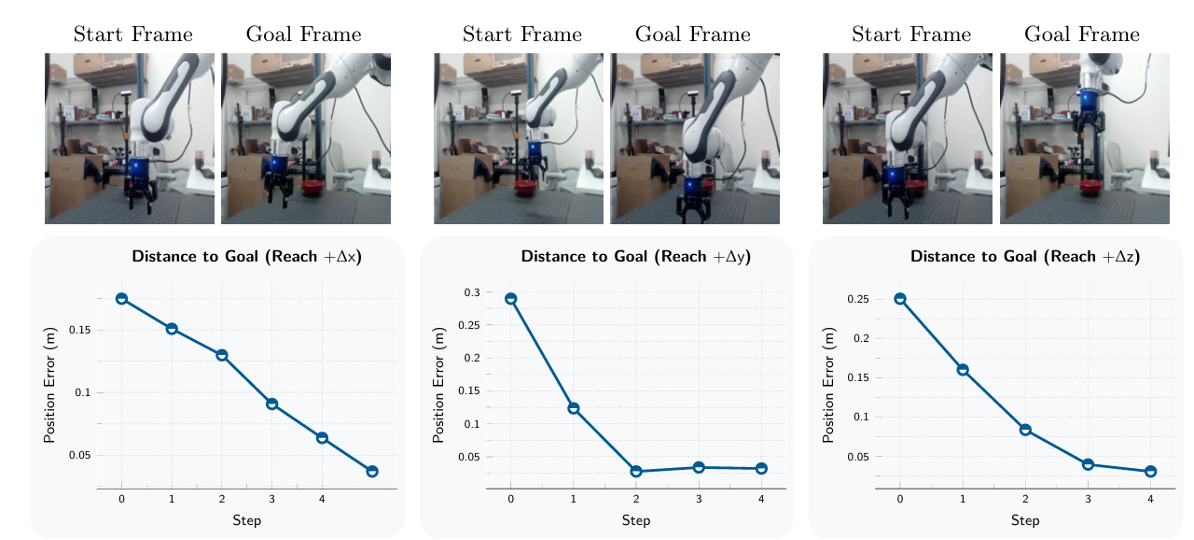
Single-goal reaching task: A task of moving the end-effector to a given location, with only a single goal Image provided.
The model performs this task using only 2D visual information received from a single RGB camera ⇒ it understands not only basic understanding of actions but also the complete 3D spatial structure, including the depth of the scene.
The graph visualizes how the Euclidean distance between the robot arm and the goal point changes as the steps progress. The model monotonically decreases the distance in all test cases, ultimately successfully approaching within 4cm of the goal position.
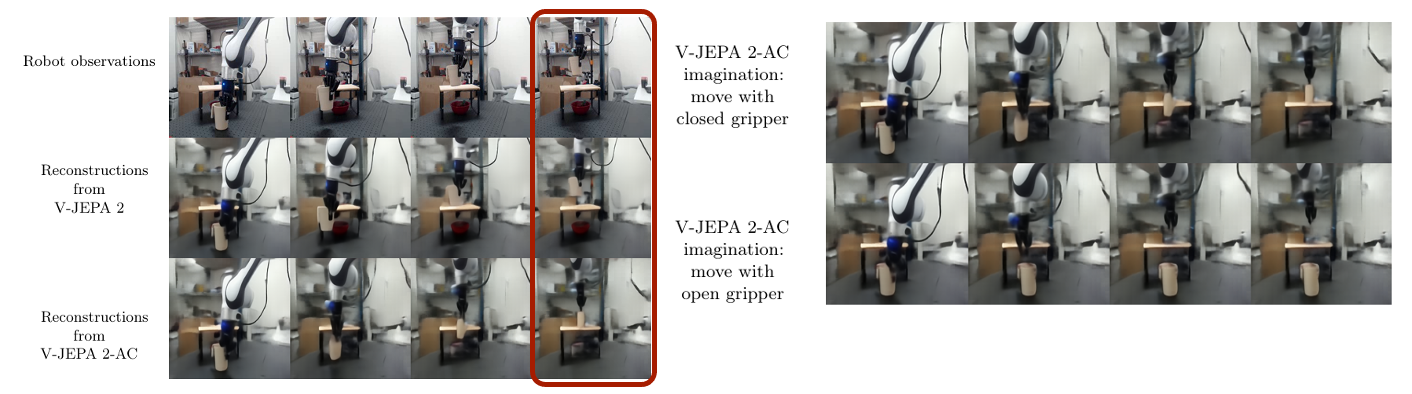
Physics: Attaching a decoder to visualize the rollout as pixels, it even predicts whether the cup follows as the gripper opens and closes. Intuitive physics. However, error accumulation is observed over long horizons.
Limitation & Discussion
Limitation
- Camera-view dependence: Since it implicitly infers the action coordinate axes from monocular RGB without explicit calibration, it is sensitive to camera position. Rotation error increases almost linearly with camera angle.
- Long-horizon planning: Due to autoregressive error accumulation and the exponential growth of the action trajectory search space, long-horizon planning is difficult.
- Image goal only: The goal is specified only as an image. Extension to language-based goals remains a task.
Discussion
- The necessity of sampling-based CEM and consequently gradient-based planning, and its validation?
- Does the frozen encoder generalize well enough to deliver sufficient performance even when the arm type changes?
- Is the physical understanding at the level of being ‘physically accurate’?