Standalone Deep Learning Ep.26
Standalone Deep Learning
KAIST Idea factory YouTube lecture
Theory
RNN
- Classical Approach for Time Series Analysis
- Time domain analysis: width, step, height of signal
- Frequency domain analysis: Fourier analysis || wavelets
- Nearest neighbors analysis: Dynamic time warping
- Probabilistic Model: Language modeling
- (S)AR(I)MA(X) models: Autocorrelation inside of time series
- Decomposition: Time series = trend part + seasonal part + residuals (decomposition)
- Nonlinear Dynamics: Differential Equation
- Machine Learning: hand made features → use ML model
- One hot encoding: converting a vocabulary set into numbers so that computers can understand it
-
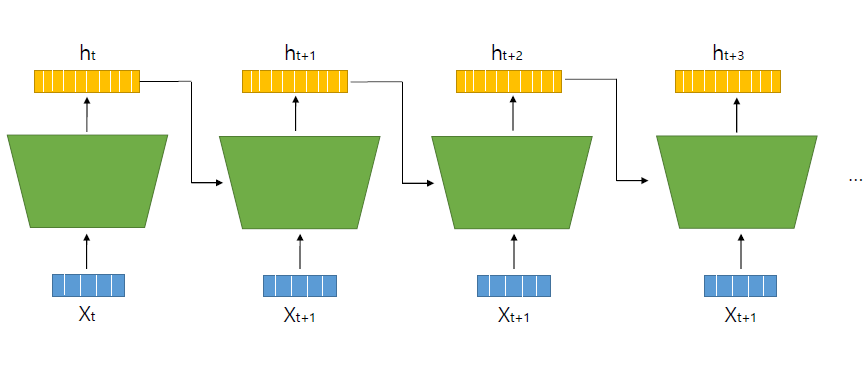
The structure of RNN
-
So how is the new input combined with the output of the previous hidden state?
\[h_t = f_W(h_{t-1}, x_t)\]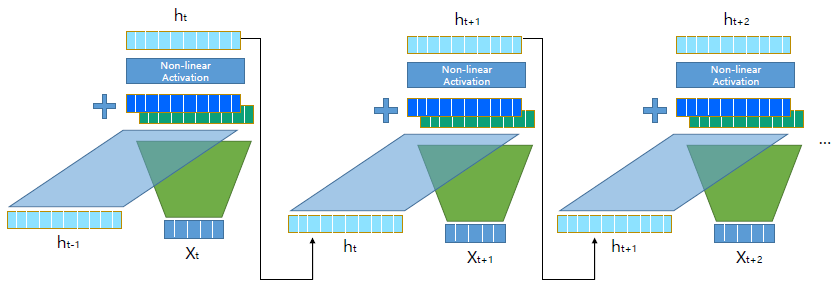
Why are they ‘added’ element-wise?
- In terms of the formula, the new \(h_t\) becomes the result of taking both \(h_{t-1}\) and \(x_t\) as inputs and processing them with a function called \(f_W\). Here, \(f_W\) uses functions such as tanh.
- Depending on the case, for complex tasks, an MLP can be used as f!
- Inside \(f_W\), the weight matrix \(W\) is multiplied by \(h_{t-1}, x_t\). Here, this \(W\) is shared as the same value across all time steps within a single layer.
-
That is, rewriting the formula in the image gives
\[h_t = tanh(W_{hh}h_{t-1} + W_{xh}X_t)\]and here, there are three kinds of \(W\):
- \(W_{xh}\) used for input data X → h
- \(W_{hh}\) used for h → h (a square matrix)
- \(W_{hy}\) used for h → Y
- In terms of the formula, the new \(h_t\) becomes the result of taking both \(h_{t-1}\) and \(x_t\) as inputs and processing them with a function called \(f_W\). Here, \(f_W\) uses functions such as tanh.
-
So what kinds of Sequential Data can be handled with RNNs?
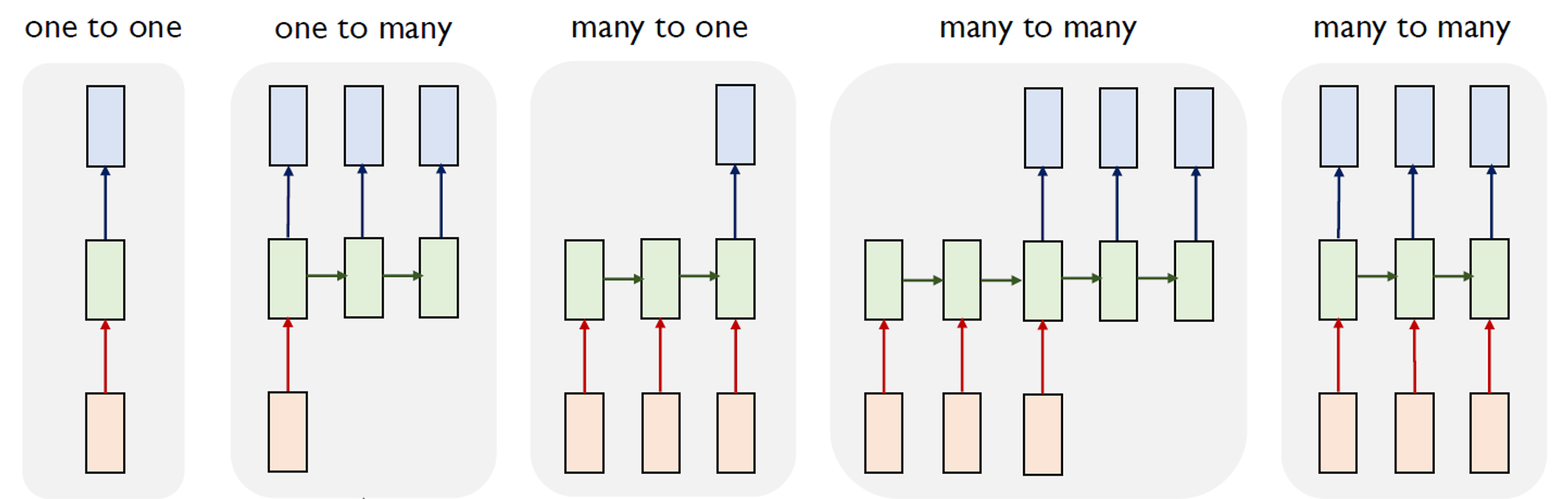
Expand examples
-
One-to-many
e.g., Image Captioning (image → sequence of words)
- Input: only initial time step
- Output: outputs from every output layers of each time step
-
Many-to-one
e.g., Sentiment Classification (sequence of words → sentiment)
- Input: sequence
- Output: an output from a single time step
-
Sequence-to-sequence 1 (Many-to-many)
e.g., Machine Translation (sequence of words → sequence of words)
- Input: sequence of words
- Output: after all the inputs are taken, outputs sequence of words
-
Sequence-to-sequence 2 (Many-to-many)
e.g., Video Classification on Frame Level
- Input: sequence
- Output: on real-time, outputs sequence for every time steps
-
In an RNN, then, what is one epoch, one iteration…? Didn’t understand the lecture
- Multiple sequences can be forwarded in parallel within a single batch
What if the Input or Output Sequence lengths differ?
- Set a max input length and truncate
- Utilize eos, ios tokens
- Evaluation of RNN
-
Calculate Loss of RNN
e.g., many to many
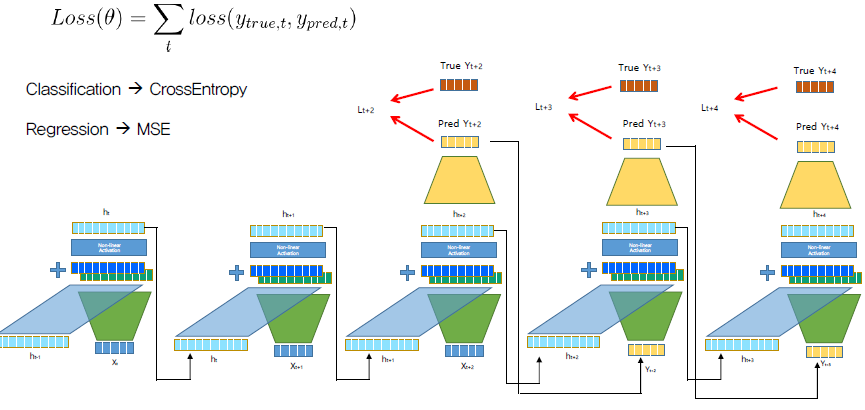
- For Loss, use CE for classification, and MSE for regression problems
-
Problems of vanilla RNN
- Gradient Vanishing ⇒ solved with LSTM, etc.
-