Simplicits: Mesh-Free, Geometry-Agnostic, Elastic Simulation
Motivation
FEM is usually the standard for existing soft body simulation, but the problem is that there is no guarantee the input is always a mesh. As 3D representation methods have diversified, the need for a geometry representation agnostic soft body simulator has emerged.
Contribution
- Representation agnostic: unifies 3D representations into a single occupancy interface
- Uses a Neural Field as the deformation basis
- Data-free physics training: no simulation trajectory dataset is needed
Method
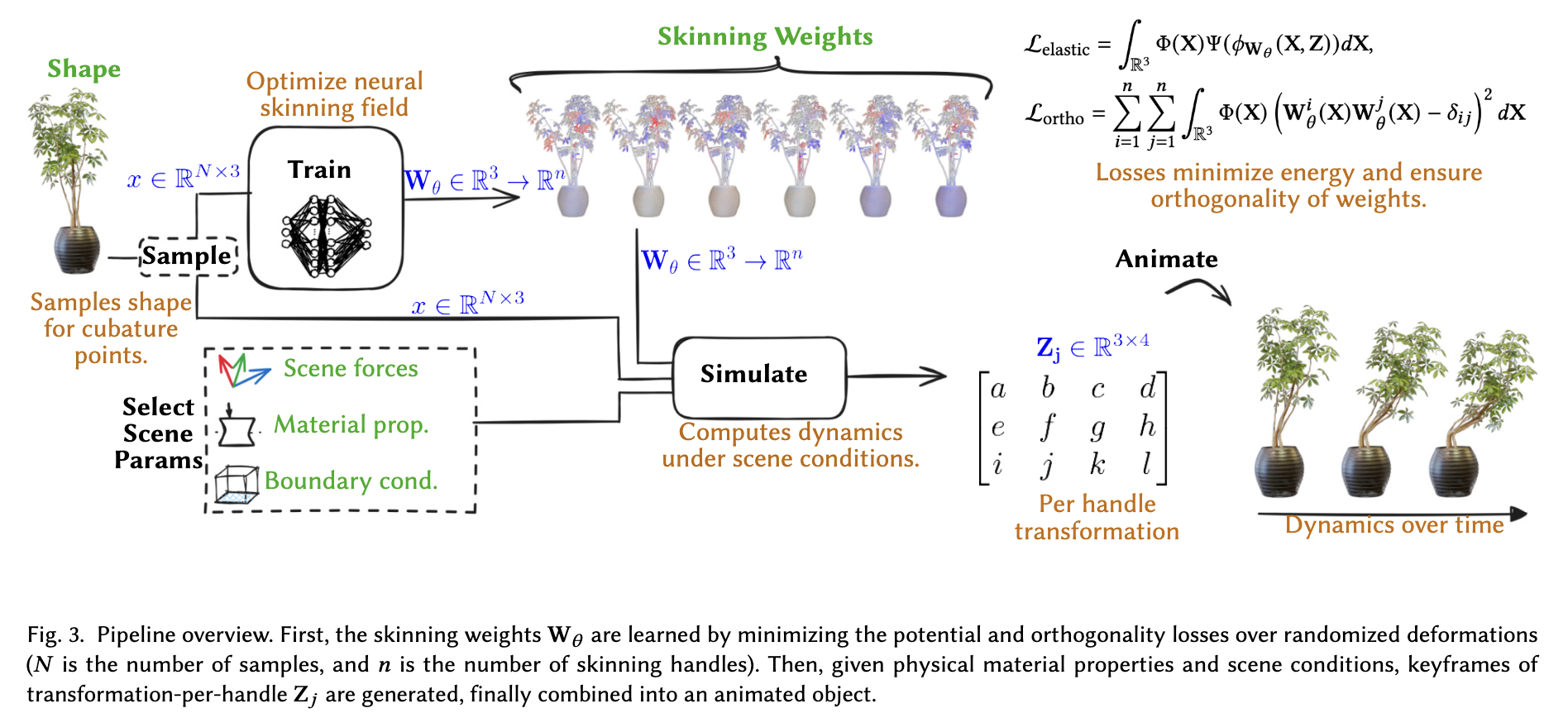
The core observation of the paper is that any 3D representation can ultimately be turned into a function that queries “is this coordinate inside or outside the object?”. If this function is set as the occupation function \(\Phi(x)\), then a value of 1 means x is inside the object, and 0 means x is outside.
For example, with a Mesh one can run an inside/outside test, with an SDF one can look at the sign, and NeRF/Gaussian Splat can use density. CT scans can also form occupancy by thresholding density/Hounsfield units. The paper holds that, thanks to this common interface, a per-representation simulator is not needed.
Linear Blend Skinning(LBS)
Here, LBS is used to express deformation without a mesh.
In areas where graphics are used, such as games, animation, and VFX, there is usually a process called ‘rigging’, which makes the surrounding vertices of a mesh follow along when a bone is moved in animation.
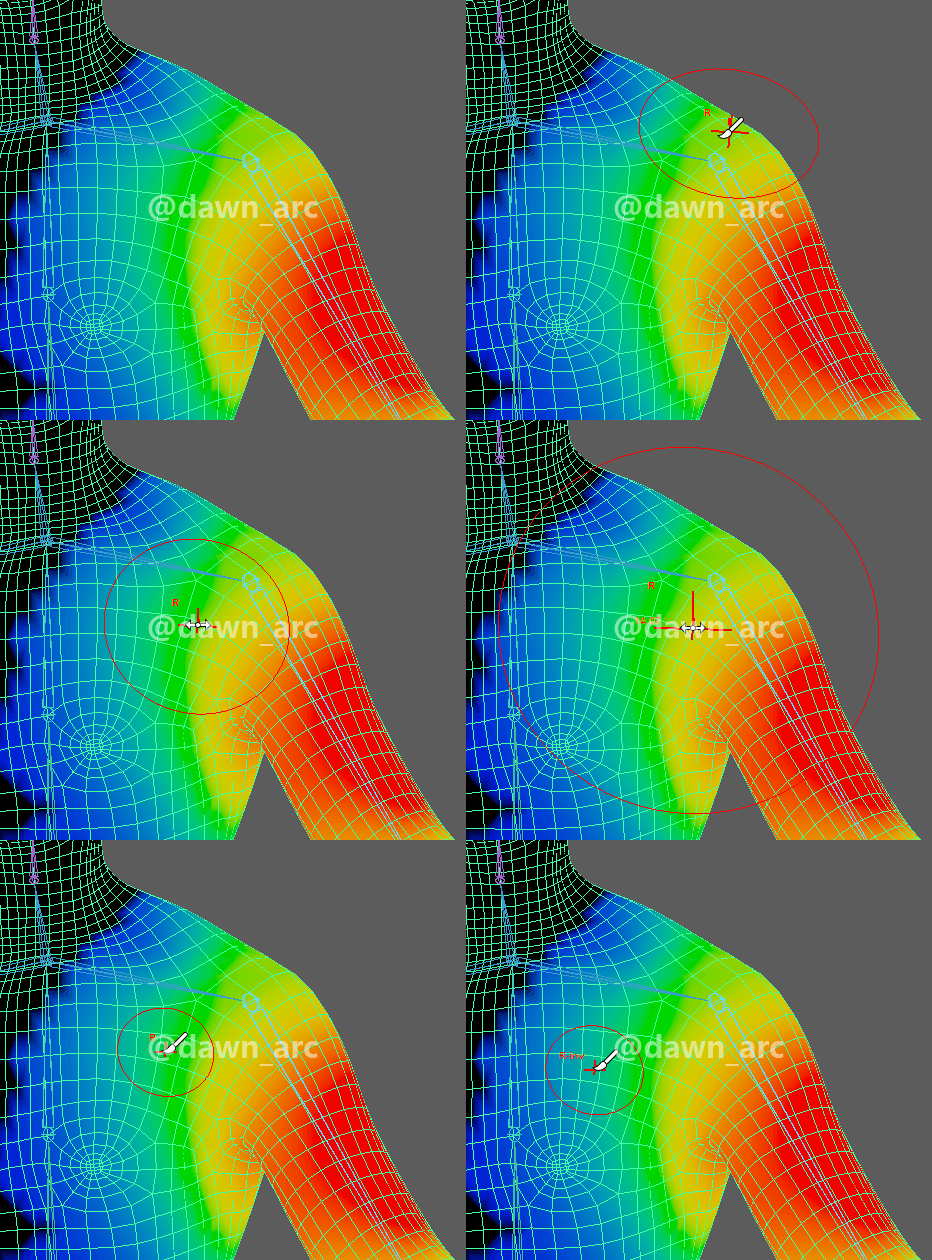
The Mesh Skinning process. Usually an artist does this directly, adjusting skinning weights and painting them on like a brush. Source: 玄冬Wong
In such skinning, there is generally a concept of weight. For example, it expresses that “this vertex follows bone 1 by 70% and bone 2 by 30%”.
Similarly, the Simplicits paper borrows this concept.
For a position \(X\) inside the object,
\[W_1(X), W_2(X), \ldots, W_n(X)\]a skinning weight field is built like this, and an affine transformation \(Z_j\) is placed on each handle.
The deformation equation is then formed as
\[\phi(X,z) = X + \sum_{j=1}^{n} W_j(X) Z_j \begin{bmatrix} X \\ 1 \end{bmatrix}.\]like this. That is, the entire deformation of the object is expressed as a combination of a small number of handle transformations.
Here the weight field \(W_\theta:\mathbb{R}^3\rightarrow\mathbb{R}^n\) is learned with an NN. During training, a small MLP is used that takes a 3D position \(X\) as input and outputs how much this position is influenced by each deformation handle. It is interesting that \(W_{\theta}\) is learned data-free, and the training loss is as follows:
\[L = \lambda_{\text{elastic}} L_{\text{elastic}} + \lambda_{\text{ortho}} L_{\text{ortho}}.\] \[L_{\text{elastic}} = \int \Phi(X)\Psi(\phi(X,Z))dX\]That is, by randomly deforming the handles, the skinning weights are learned so that the elastic energy of the deformation becomes lower. However, with only the elastic loss there is a trivial solution like rigid motion where all handles move almost together, so to prevent model collapse an orthogonal constraint term is used. This makes each skinning weight responsible for a different deformation mode.
Note that here the NN plays the role of finding an appropriate reduced deformation basis, not a neural simulator.
Reduced-order Simulation
Using this method, the DOF can be greatly reduced. For example, if a typical FEM has 100,000 vertices (nodes), the DOF becomes 3*100,000. However, since Simplicits reduces the deformation points with a small number of handles, and each handle is an \(3 \times 4\) affine transform, the simulation DOF becomes \(z \in \mathbb{R}^{12n}\).
Monte Carlo Sampling
In mesh-based FEM, the elastic potential energy is computed as
\[E_{\mathrm{pot}} = \int_{\Omega} \Psi(\phi(X)) d\Omega\]However, since there are no tetrahedral elements, the paper uses Monte Carlo Sampling. Using the occupancy function,
\[G = \int_{\mathbb{R}^3} \Phi(X) g(X) dX\]sample points inside the object are drawn like this and the integral computation is performed.
Simulation loop
Once NN training is done, simulation proceeds with a Newton solve. Time integration is expressed in an optimization form as follows:
\[z_{t+1} = \arg\min_{z} \frac{1}{2}\Vert z - \tilde{z}_t\Vert _M^2 + h^2 E_{\text{pot}}(z).\]Optimizing in this way converges to a state that 1) preserves inertia while 2) keeping the elastic energy low. And a single step is composed in the order of handle transform → deformation using the \(z\) found this way.
Result
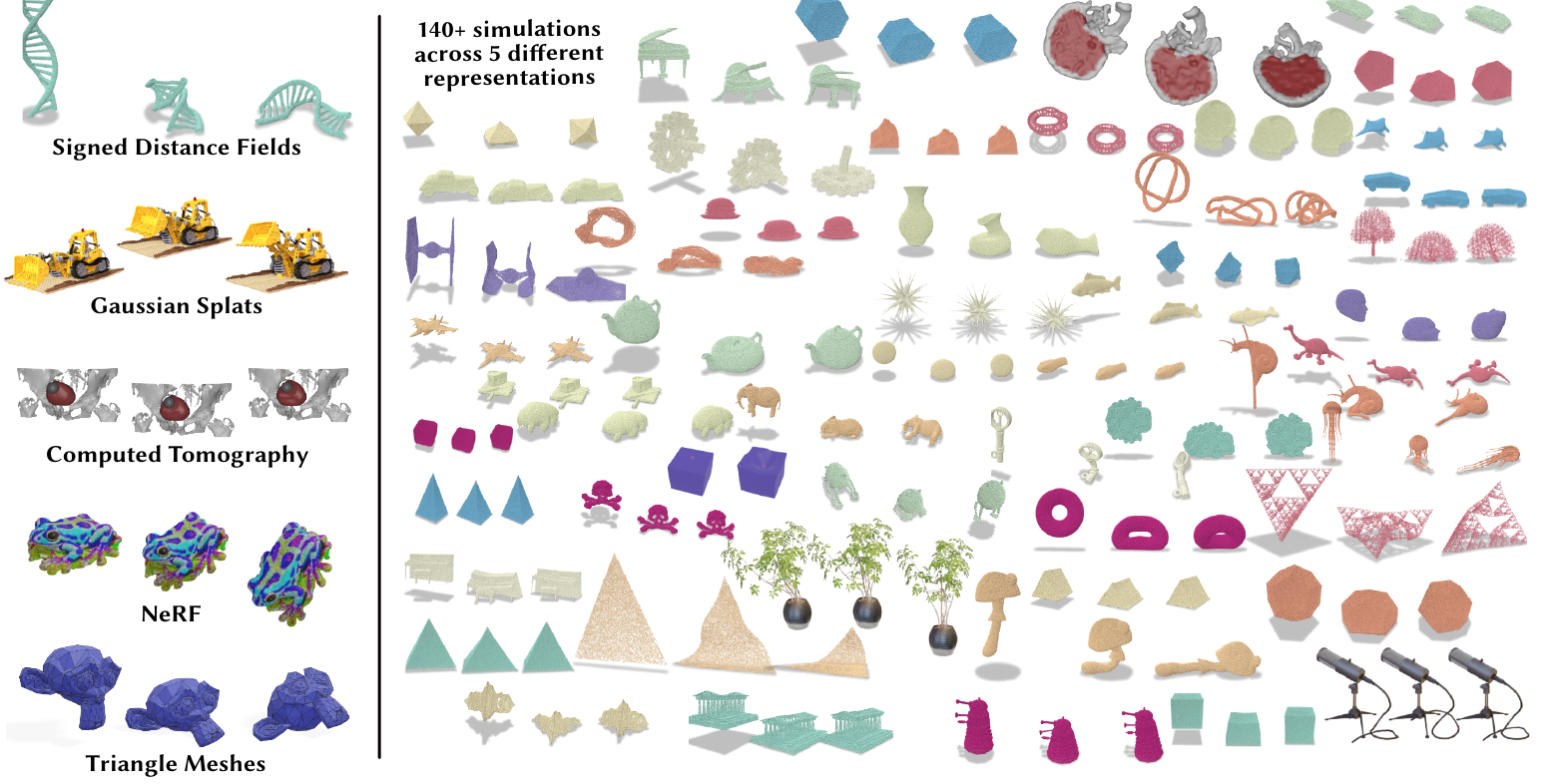
About 140 objects of different representations, including Mesh, SDF, point cloud, Gaussian Splat, NeRF, and CT scan, are all simulated with the same pipeline.
Accuracy
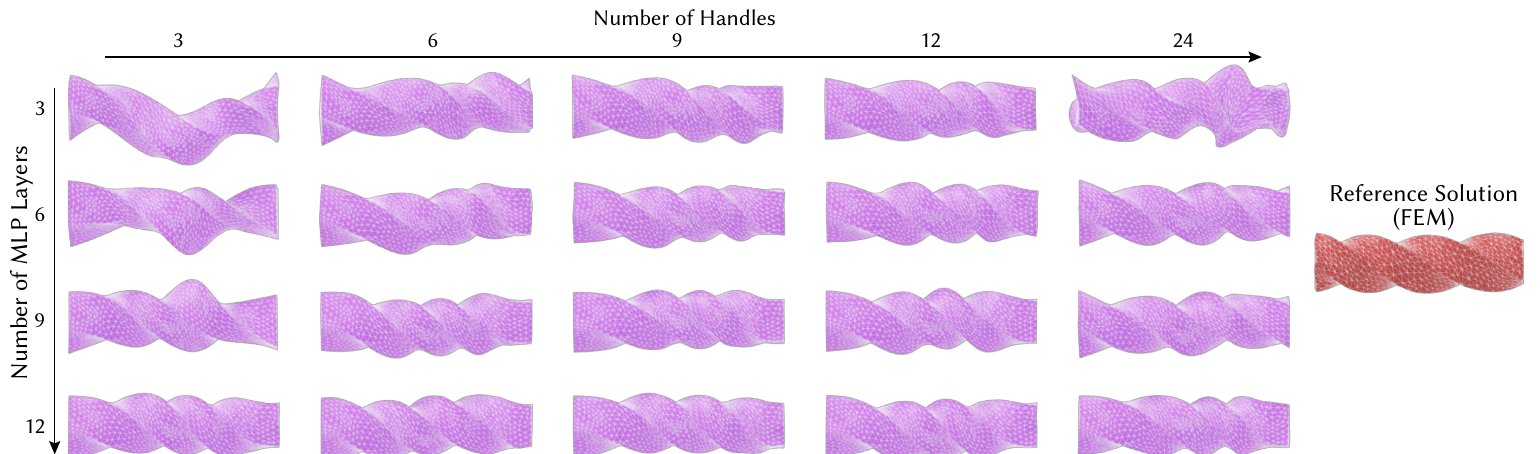
A Twisted bar is compared with linear tetrahedral FEM (red). As the number of handles and the number of MLP layers increase, it gets closer to the reference. However, when the network capacity cannot keep up with the DOF, as with 3 layers + 24 handles, it instead breaks. When increasing the handles, the network must also be scaled up together.
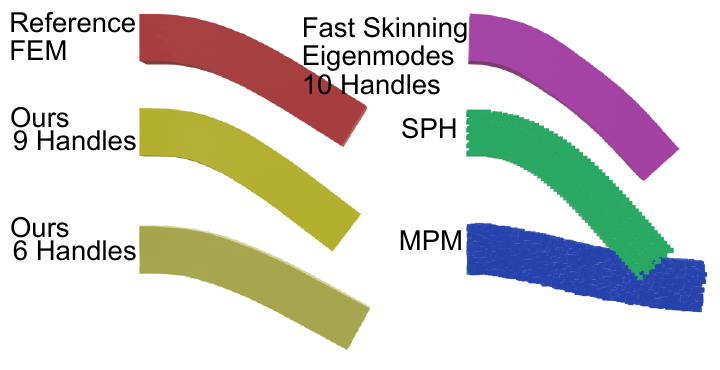
Cantilever bar comparison. With only 6~9 handles it produces nearly the same result as Fast Skinning Eigenmodes (10 handles), a mesh-based reduced method, and is closer to FEM than other mesh-free methods like SPH and MPM (MPM collapses in shape). On the other hand, due to the reduction there is numerical coarsening where it bends slightly less than FEM.
Contact
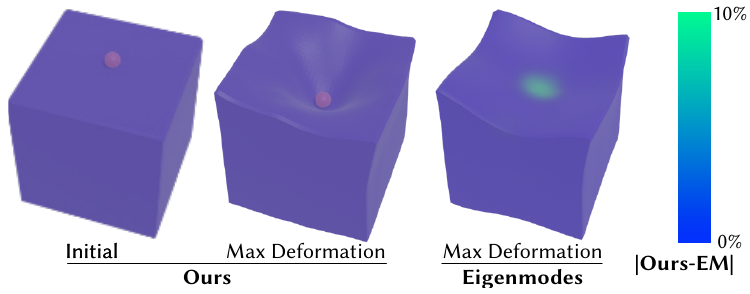
It responds to contact not seen during training. Under the same 10 modes, mesh-based eigenmodes cannot capture the localized deformation of a pressing ball, but Simplicits does.
Timing
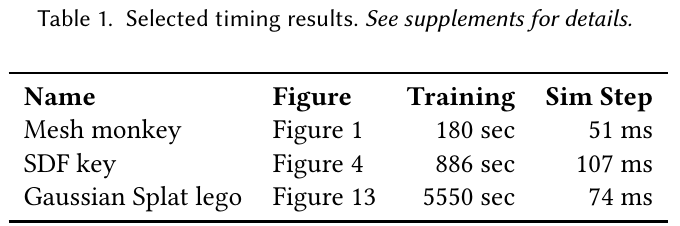
On a single RTX 3070. Training takes from a few minutes to about 1.5 hours per object, and a sim step is on the order of tens to 100ms, so it can run interactively. Training cost depends on network size rather than the number of handles, and the sim step grows super-linearly with the number of handles due to the dense Newton solve.
Limitation & Discussion
- A neural skinning field must be trained separately for each object. That is, when a new object comes in, preprocessing/training is needed again.
- When the internal stiffness of the object changes in complex layers, training convergence can be difficult.
- And for implicit volumetric representations like NeRF, the problem of re-rendering the deformed state is not easy, rather than the deformation itself.