Learning Mesh-Based Simulation with Graph Networks
本 논문 포스팅은 Learning to Simulate Complex Physics with Graph Networks 논문을 읽고, 후속 연구를 조사하며 짧게 작성된 노트입니다.
This posting is a short note written after reading the paper Learning to Simulate Complex Physics with Graph Networks and surveying follow-up research.
Intro
Motivation
How should simulations be predicted in cases like elastic bodies, where both internal system and external contact information are needed?
Highlights
-
Multigraph: In addition to the vertices & edges of the mesh, edges based on distances in world space are also utilized:
\[G = (V, E_M, E_W).\] - Learned remeshing: Not only the physical quantities but also the size field for adaptive remeshing is learned.
- Lagrangian AND Eulerian system: Unlike GNS, which handles only particle-based systems, this encompasses Eulerian systems.
Method
Learning Forward Dynamics
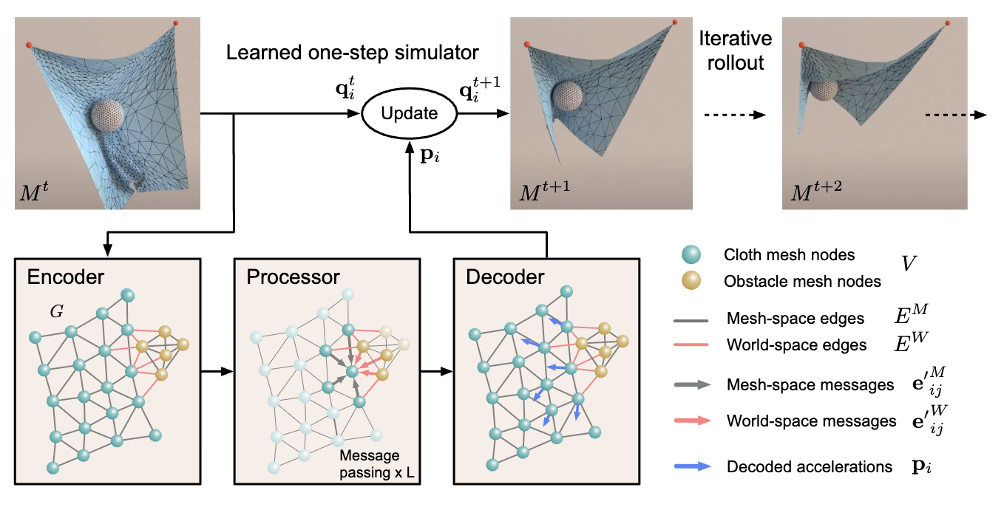
It utilizes a relational multigraph structure that uses a separate edge set and parameters for each different semantic relation. Message passing and aggregation happen separately, but they are merged when finally updating the nodes. However, since the node pairs are fixed, this must be distinguished from a heterogeneous graph.
Adaptive Remeshing
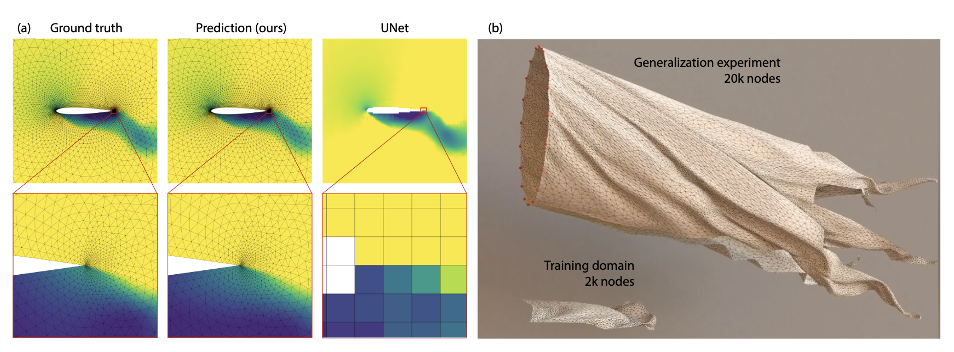
- It is trained to predict, along with the physical quantity \(M_{t+1}\) at time t+1, the size field \(S_{t+1}\) as well.
- Heuristic remeshing (curvature or gradient threshold) → learn the size field, then after prediction, apply an algorithm that splits/collapses/flips edges based on it.
- size field: a tensor encoding the maximum allowed edge length at each node of the mesh.
⇒ Through this, simulation performance can be extended even to objects with complex shapes not seen in the training data.
Experiments
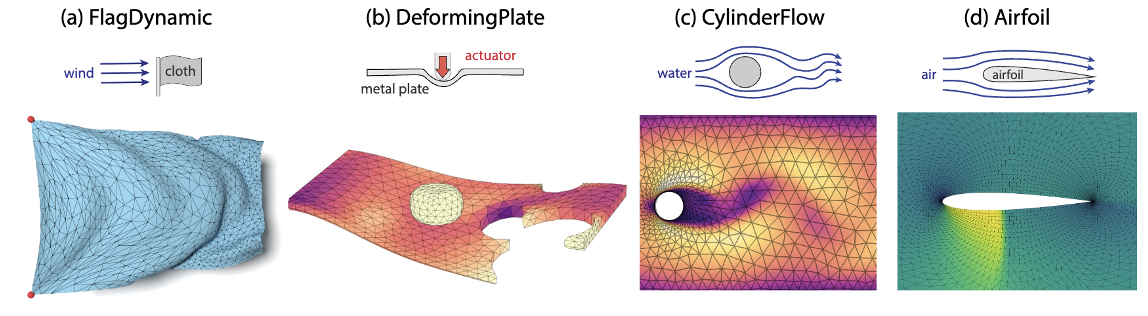
- The goal is inference that is about 1–2 orders of magnitude faster than ground-truth solvers.
- Long rollouts are performed across various domains.
- GNS diverges in (a).