3D Vision with Transformers: A Survey
3D Vision with Transformers: A Survey
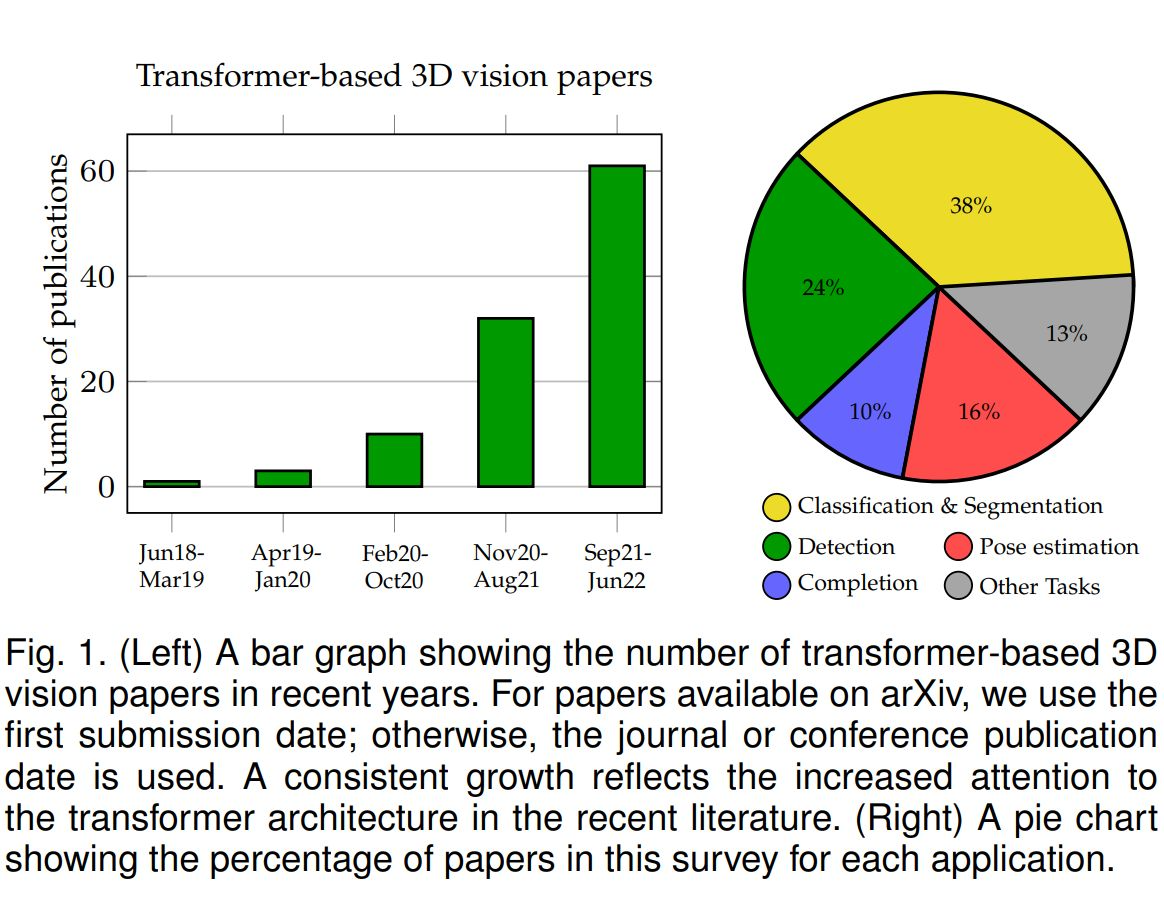
Research on Transformer-based 3D Vision is reportedly on the rise. Within this field, Classification & Segmentation accounted for the largest share, followed by Detection and Pose estimation, respectively, as the most heavily studied areas.
In the 3D Vision domain, among the various 3D representation methods, the point-based approach was the most dominant. Voxel-based approaches also appear from time to time, but they inevitably have limitations in increasing resolution.
Transformer Design in 3D Vision
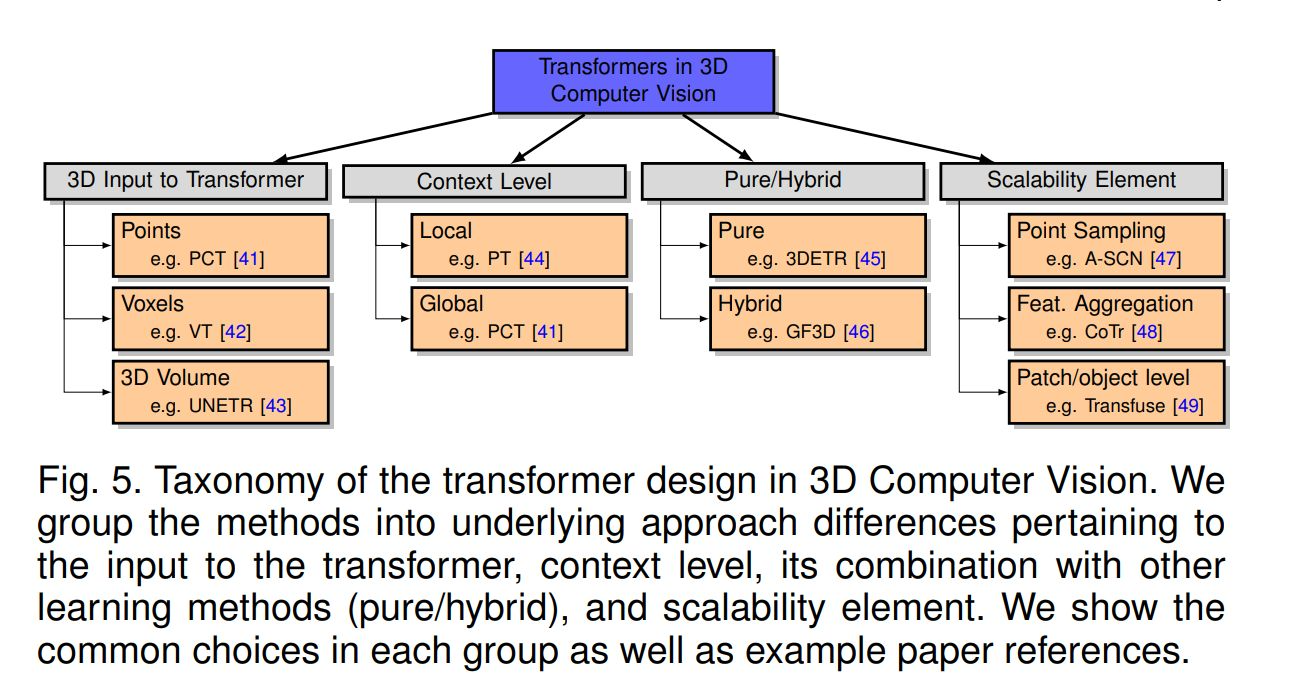
In the point-based approach, a point cloud is a set, and since it can exist in different lengths, it has more in common with words in a sentence than with images. This seems to be the explanation for why it is well-suited to Transformer-based approaches. Each element of the figure is examined below:
- 3D Input to Transformer: Each coordinate of each point in the point cloud is fed as input. Additional necessary features can also be provided, such as color, normals, and so on. Appropriate sampling is required. On the other hand, there is also a method that does not use points directly but converts them into a grid, in which case it becomes a voxel-based approach.
- Context Level: To capture both fine-grained information and global context, data processing at different scales is necessary. When using a transformer in a local manner, feeding the entire point cloud as input all at once is both unnecessary and computationally difficult. A balance is needed between point cloud coverage and point density.
- Pure and Hybrid Transformer: One must also decide whether to use only a pure self-attention-based transformer, or to combine it with a non-transformer model structure. The transformer can be used for extracting richer features, and a non-transformer-based structure can be used for local features.
- Scalability: 3D data carries quite a lot of information compared to other data handled by transformers. Therefore, consideration of input size is necessary. Sampling schemes for reducing input size include farthest point sampling for point clouds with kNN feature aggregation, voxel feature aggregation for low-resolution volumetric representation, patch feature embedding, feature downsampling using CNN-based methods, and object level self-attention, among others.
Transformers in 3D Vision: Applications
Setting aside the most active fields mentioned earlier, two interesting areas are examined below.
3D Point Cloud Completion
This is a task that takes a partial point cloud of an object and generates the point cloud for the remaining region.
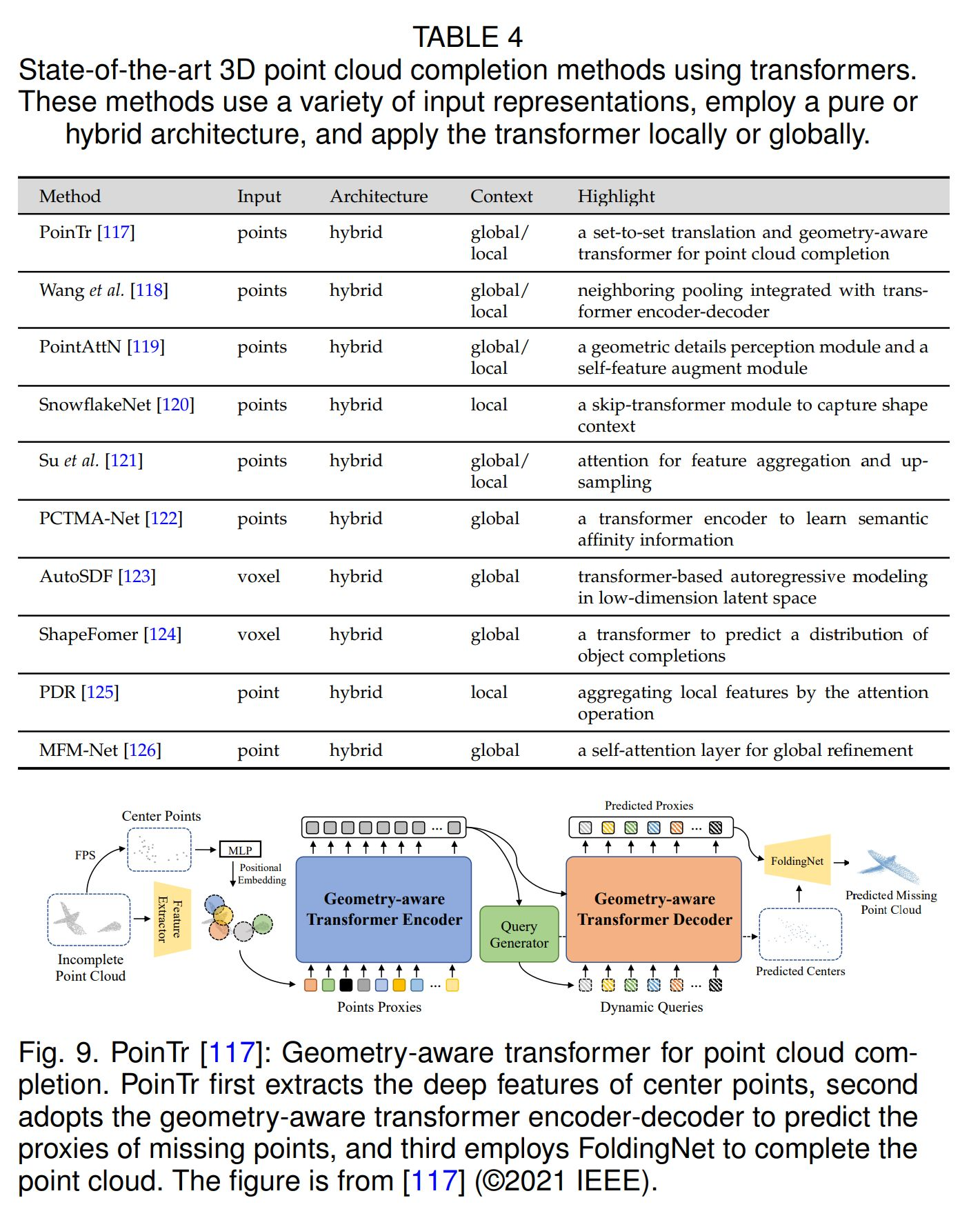
Fig.9 shows the architecture of the PoinTr model. This model views the task from the perspective of a set-to-set translation task, and predicts the missing point cloud through a geometry-aware Transformer. In the case of the geometry-aware Transformer, it differs from the vanilla transformer in that it is split into two branches, each extracting semantic features via self-attention and geometric features via kNN. Afterwards, the output features of the two branches are finally combined. As with sentences, there are also cases where the encoder/decoder is used on its own.
Pose Estimation
This is a task that estimates the positions of 3D joints from images or videos.
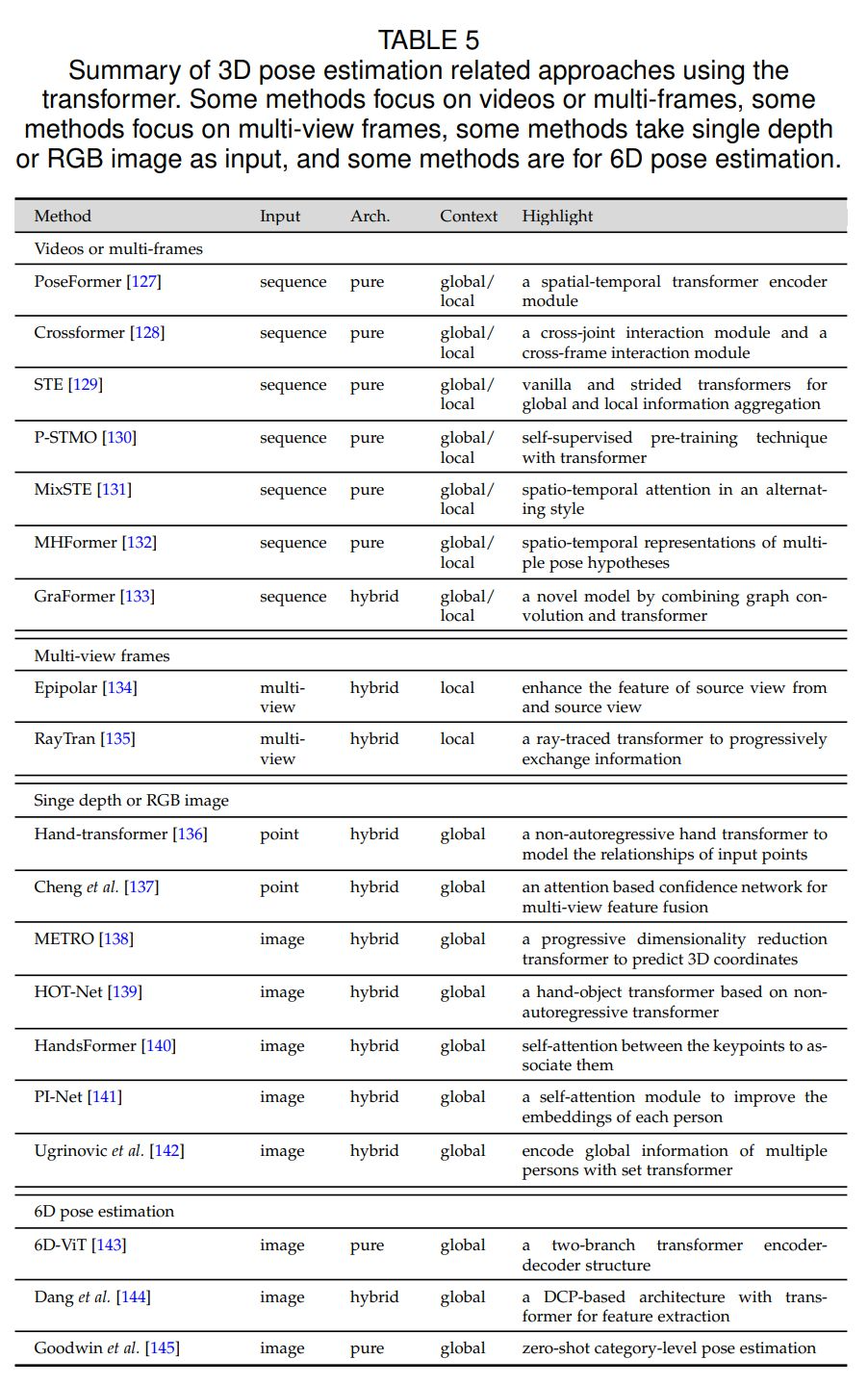
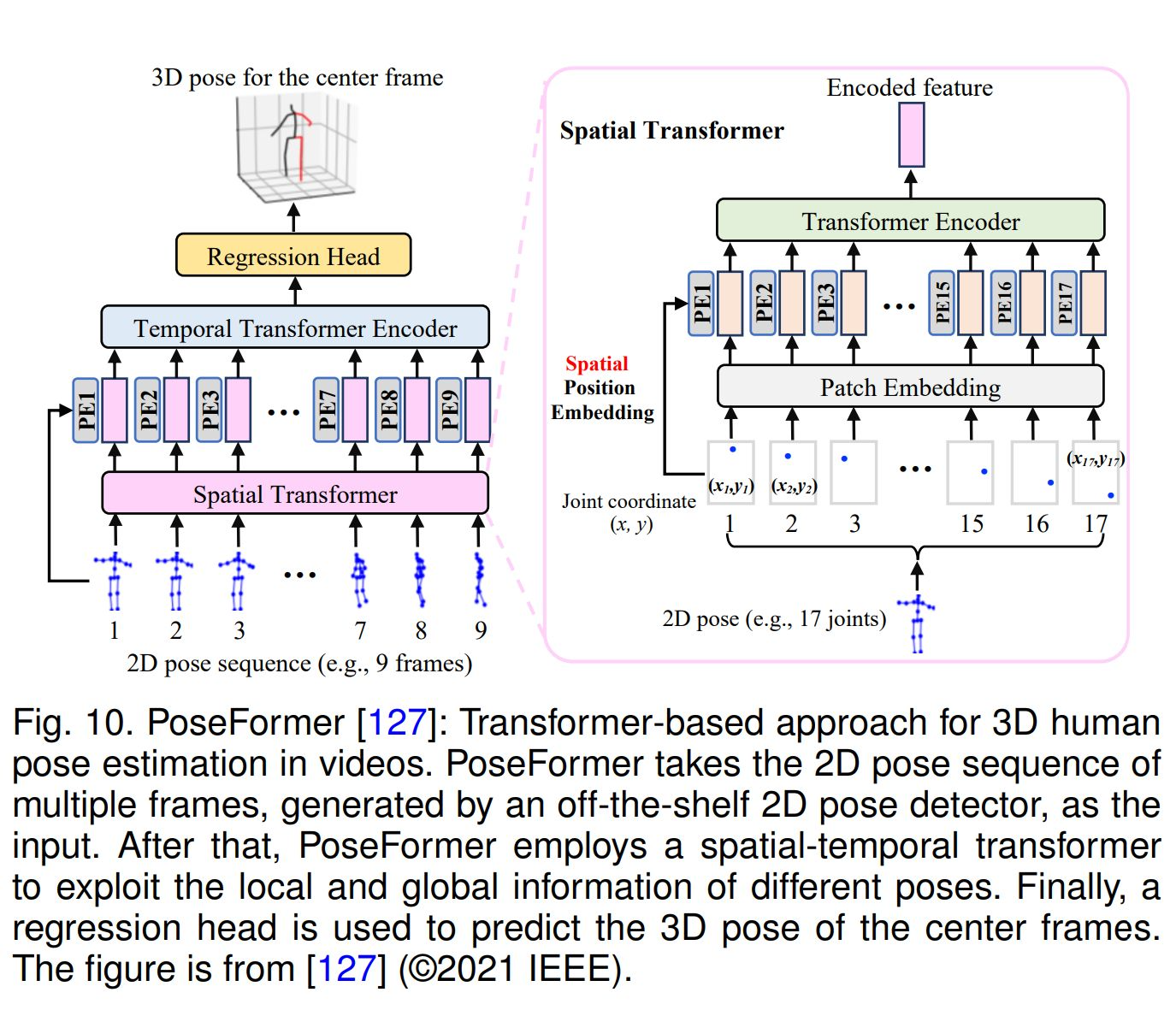
Fig.10 shows the architecture of Poseformer, a representative pose estimation model. This model utilizes a spatio-temporal transformer encoder. Through this, it models local relations within a single frame and global relations between frames, but it has the limitation of lacking locality. Subsequent approaches address this through cross-joint interaction, approaches that progressively synthesize long-term information into a single 3D representation using a vanilla transformer, or approaches that additionally use self-supervised pre-training methods.
3D Gaussian Splatting: Survey, Technologies, Challenges, and Opportunities
This is a fresh survey paper that focuses more on 3DGS and examines its Tasks and Technologies, allowing a look at technologies not covered in previous surveys:
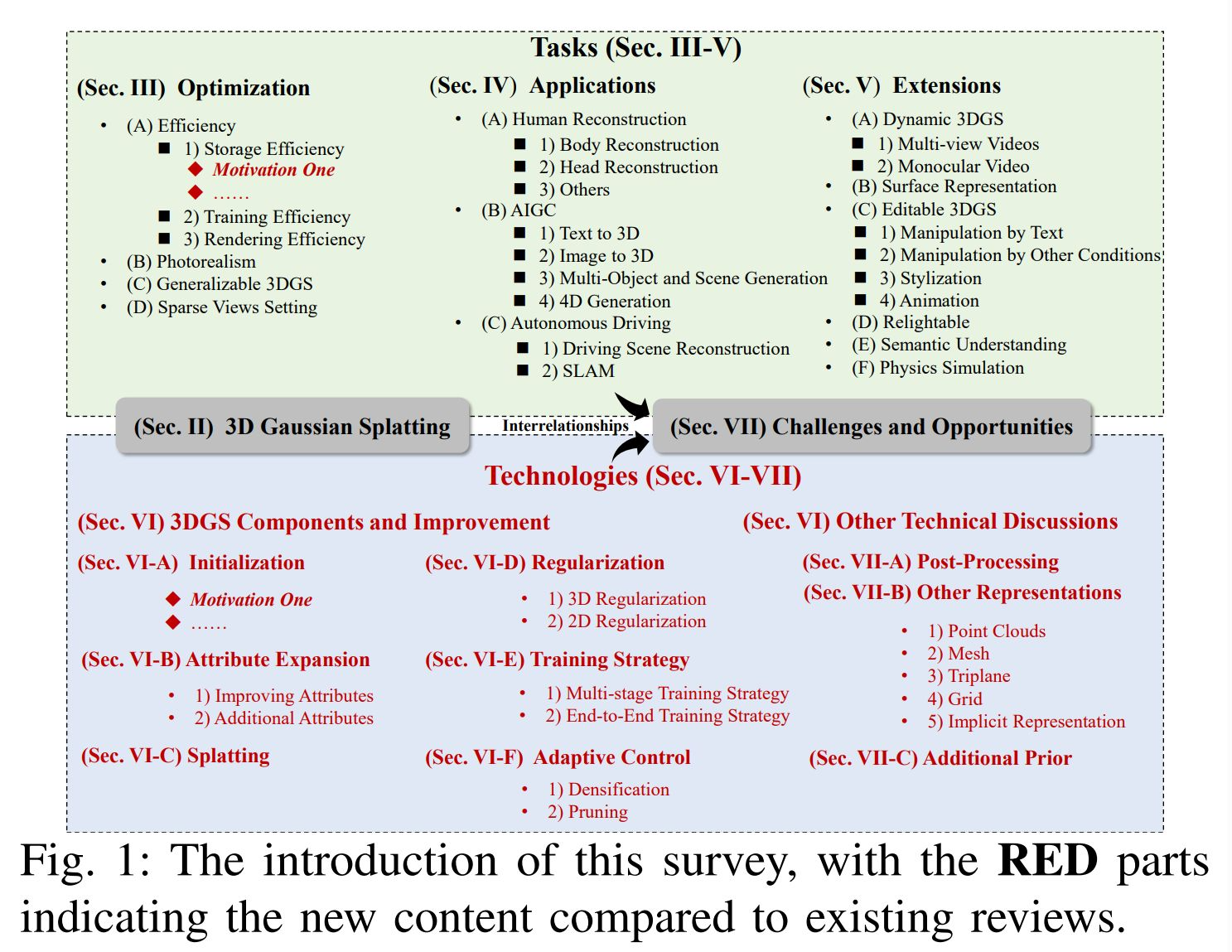
1. Optimization of 3D Gaussian Splatting
A. Efficiency
For Efficiency, three approaches are possible:
- Storage: There are three directions: Vector Quantization, research on efficient pruning strategies, and improving the Gaussian representations or attributes themselves.
- Training: I didn’t fully understand this, but it is explained based on the problem that atomic updates become numerous in differentiable rendering operations, causing bottlenecks. A chunk of threads on a GPU is called a warp, and the method introduced optimizes atomic updates by leveraging spatio-temporal locality within a warp, and resolves the variability in atomic traffic between warps.
- Rendering: It points out that improving storage efficiency in turn increases efficiency.
B. Photorealism
While there is research that focuses on photorealism in the vanilla setting, there is also research that concentrates on reflective surfaces or deblurring.
- Reflective surfaces: GaussianShader focuses on reflective surfaces reconstruction through a hybrid color representation, specular GGX, and a normal estimation module, but the normal estimation module used here is somewhat lacking in computational efficiency. In response, the 3d gaussian splatting with defered reflection study improves reflection by first storing geometric information in screen space and then performing per-pixel shading, thereby securing computational efficiency.
C. Generalizable 3DGS
Models like MVSplat handled the generalizable 3DGS task with cost volume representation + depth prediction using plane sweeps in 3D space, but they had limitations in field of view, as well as the problem that contaminated data could be used in Gaussian primitive learning. Models like FreeSplat and DGGS attempted to address MVSplat’s limitations through Pixel-wise Triplet Fusion + distractor-free training & inference. Currently, research is being conducted on performing generalizable tasks even in dynamic scenes by additionally using LiDAR data, and on the 3DGS generalization task via the introduction of Triplane, among others.
2. Applications of 3D Gaussian Splatting
This chapter introduces approaches to Human Reconstruction, AIGC, and autonomous driving. Of these, only AIGC is summarized here:
- Text to 3D Object: Early research proceeded based on the SDS method, which generates by extracting an explicit representation such as a mesh. However, this method had limitations such as excessively high saturation, over-smoothing, and lack of detail. In response, several directions were attempted: 1) addressing these limitations while still using SDS, 2) approaching in a Feedforward manner without SDS, 3) using Triplane + Sketch, and 4) directly combining 3DGS into a 3D generative model.
- Image to 3D Object: This has the same core as Text to 3D, and directions utilizing approaches similar to NeRF are described. A model utilizing repainting is introduced.
- Multi-Object and Scene Generation: This extends from generating only a single object to generating multiple objects or an entire scene. Read CG3D and LucidDreamer.
- 4D Generation: There are methods such as static 3DGS generation → generating 4DGS with a text-to-video-based SDS loss, or maintaining temporal consistency with Hexplane-based multi-scale features, and, at the same time, approaches that animate the 3DGS of canonical space altogether.
3. Extensions of 3D Gaussian Splatting
Among the Extension directions, the Relighting and Physics Simulation parts are introduced below, as follows.
D. Relightable
The main approach to the Relighting task is to separate texture and lighting. Early work used a method of representing a scene as splats and BRDF and decomposing lighting attributes, but it had weaknesses in reflective scenes. In response, GaussianShader, also mentioned earlier in the Photorealism section, resolved these limitations to some extent using a novel normal estimation method and residual color terms. Other approaches include OLAT-GS, which handles textures such as translucent volumes or animal fur, and $GS^3$, which attempted to handle self-shadowing and global illumination by combining spatial + angular Gaussians + utilizing a NN.
F. Physics Simulation
Although hardly introduced, there is an approach using the MPM method and a study that attempted interactive simulation in VR. In studies using the MPM method, PhysGaussian and PhysDreamer can be examined, and the VR approach can be examined in VR-GS.
4. 3DGS Components and Improvements
This part presents several directions for Attribute Expansion. Among them, in the case of SH, while reading the paper I frequently saw cases where, especially when moving to dynamic tasks, it was not used at all, resulting in view-dependent color not coming out properly. A method that attaches a Hash Grid and MLP to encode the color altogether was introduced.